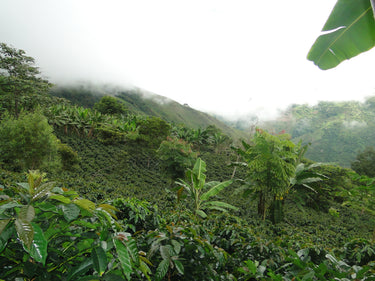


This peaberry coffee comes from the Iyego factory in Murang’a County, on the slopes of Kenya’s Aberdare Mountain Range. Here, fertile red volcanic soils and warm days followed by cooler nights create ideal conditions for coffee cherries to ripen slowly and develop sweetness.
The Iyego Farmers Cooperative Society (FCS) established its first factory in 1959 with just 182 members. Today, it supports more than 1,600 registered smallholder farmers at Iyego and operates eight other factories, reaching around 10,000 farmers in total. Farmers delivering to Iyego primarily grow SL28, Ruiru 11, Batian and K7 varieties on small plots, typically around one hectare. “Peaberry” refers to a naturally occurring mutation where, instead of the usual two flat-sided beans, a coffee cherry develops a single, rounder bean. As this can’t be identified from the outside of the cherry, peaberries are separated during dry milling.
Once harvested, cherries are delivered to the factory and carefully sorted before being pulped and fermented for 12–24 hours. The coffee is then soaked in clean water for 24 hours, a traditional step that can enhance sweetness and complexity while improving clarity in the cup. Finally, the parchment is transferred to raised drying beds or solar dryers, where it is regularly turned and protected from the hottest sun and nighttime moisture. Drying takes around 7–21 days, depending on the weather, before the coffee is bagged and prepared for dry milling and export.
- 🌟 New release


Kenya Iyego PB Nº 362
From £10.01
Tastes Like:
Molasses, Raspberry Jam, Cocoa
Roast:
The peaberry grade is a sweet, small and round bean (unlike other beans, which have one flat edge). Once considered a less desirable grade, Read more
- Free delivery on orders over £25
- Roasted fresh to every order 🔥
- Dispatched next working day 📆
- 100% recyclable packaging 🟢
Delivery information
Roasted & dispatched the next working day with Royal Mail Tracked service.
Order Value
£0.00 to £9.95 = £2.95
£9.96 to £20.00 = £3.75
£20.01 - £24.99 = £3.95
£25+ = Free UK Shipping
Join our coffee club
And get the newest coffees delivered straight to you every month!
Kenya
Process
Washed
Producers
900+ smallholder farmers through the Iyego Main Factory
Grown
Kangema, Murang’a
Altitude
1600m
Varietals
Batain, K7, Ruiru 11, SL28, SL34
Ash says...
A complex and fruity coffee with a full roast applied - perfect espresso & milk drinks await.
Best-Sellers
best selling Coffee


- 🔥 Best Seller
- ✅ Subscribable
Signature Blend Nº 1
From £7.16


- 🔥 Best Seller
- ✅ Subscribable
Fudge Blend Nº 5
From £7.41


- 🔥 Best Seller
- ✅ Subscribable
Chatswood Blend Nº 6
From £7.19


- ✅ Subscribable
Brazil Guima Estate Nº 303
From £7.47


- ✅ Subscribable
Signature Blend Decaf N° 1D
From £8.96